meta data for this page
- en
This is an old revision of the document!
====== Understanding and Using Windows ====== - A comprehensive guide to the window layout element
This section explains the concept of windows within Total Launcher, detailing creation methods, property configuration, and practical applications for customized screen layouts.
What is a Window?
A window in Total Launcher operates as a pop-up or floating page. Unlike standard widgets or themes, a window is a dedicated layout container that exists above the primary background page. This architectural separation allows the main page to act as a fixed canvas, while windows serve as dynamic, floating layers that can be summoned and dismissed as needed.
Because a window functions similarly to a standard page, it can contain any combination of apps, widgets, text, and graphical objects. This makes windows ideal for constructing custom app drawers, pop-up menus, widget stacks, or floating control panels. A single window resource can be reused and triggered from any page within the launcher.
Anatomy and Core Properties
To customize a window's dimensions and placement, enter edit mode and select the window. Resizing is accomplished by long-pressing an empty area of the window and dragging the corners of the container to the desired scale. While in this resize mode, the options button provides access to structural and visual behaviors.
Modal vs. Non-modal Behavior
The interaction state of a window dictates how it affects the underlying page:
- Modal: - Blocks all interaction with the background page. The window must be dismissed before the main interface can be used.
- Non-modal: - Permits active interaction with the background page while the window remains visible on screen.
Accessing Window Settings
To configure a window or folder, follow the standard editing procedure:
- Enter edit mode on the launcher home screen.
- Select the target window or folder element.
- Select the gear icon

- Navigate to the
OPTIONSorANIMATIONtabs at the bottom of the screen to modify specific behaviors.

Window Options Configuration
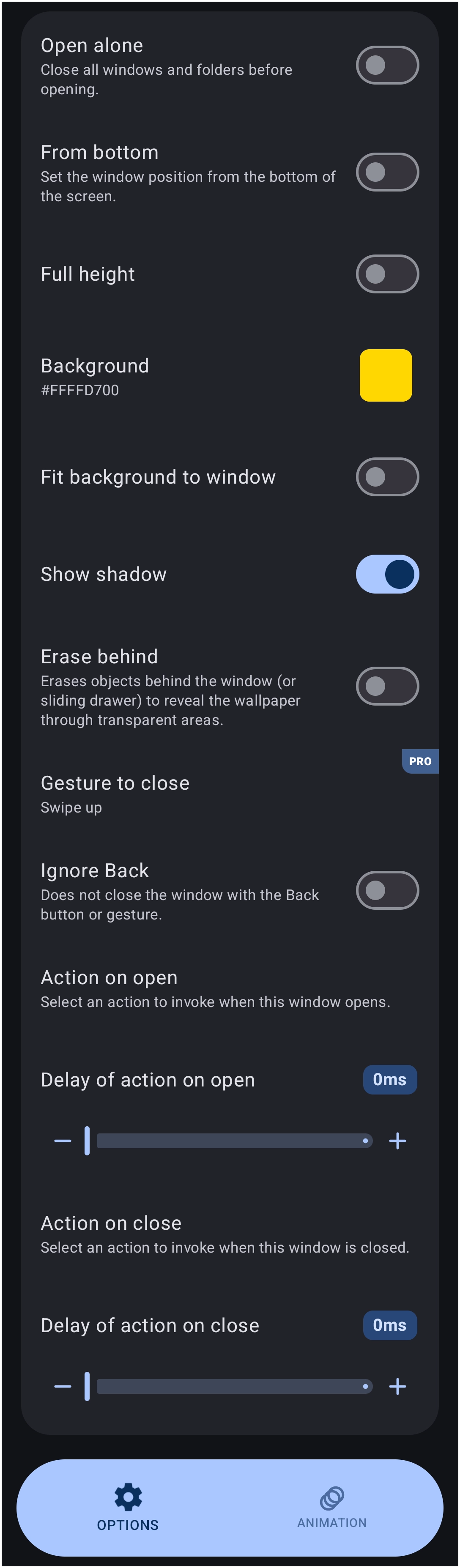
This topic covers the customization settings available for windows and folders to alter their behavior, appearance, and automation. The Window Options menu provides extensive control over pop-up windows within the launcher environment. Configuring these settings allows for a highly tailored user interface, improving device navigation, aesthetic cohesion, and functional automation.
Display and Layout Settings
These options dictate the physical appearance and screen positioning of the window.
- Open alone: - Closes all currently active windows and folders before opening the selected one. Maintains a clutter-free workspace and focuses the display on a single interface.
- From bottom: - Sets the window position to originate from the bottom of the screen. Facilitates the creation of modern bottom-sheet menus that are easily reachable for one-handed operation.
- Full height: - Expands the window to occupy the entire vertical space of the screen. Utilized for creating comprehensive app drawers or immersive custom dashboards. If
From bottomis also enabled, it stretches the window to touch the top of the screen. - Background: - Defines the background color, Dynamic color, Icon pack, Shape, Image, or Dynamic image for the window container. Here, color is represented by a hex value (e.g.,
#FFCCCCCC). Used to match the overall theme design of the launcher layout. - Fit background to window: - Adjusts the assigned background image or color to fit exactly within the window boundaries, preventing visual overflow. When disabled, the image is cropped to fit while maintaining its original proportions.
- Show shadow: - Applies a drop shadow effect around the exterior of the window. This adds visual depth and separates the active window from the underlying graphical elements.
- Erase behind: - Erases objects located behind the window or sliding drawer to reveal the system wallpaper through transparent areas. Allows for complex layering effects or custom mask cutouts.
Interaction and Gestures
These settings modify how the window responds to touch inputs and system navigation commands.
- Gesture to close: - Configures a specific touch gesture, such as
Swipe up, to close the window. Provides fast, fluid navigation without requiring precise taps on a dedicated close button. Note that this requires aPROlicense. - Ignore Back: - Prevents the window from being closed using the system Back button or system navigation gesture. Utilized for creating persistent on-screen displays, mandatory menus, or kiosk-style locked interfaces.
Automation and Actions
Automated actions can be triggered based on the window's lifecycle state.
- Action on open: - Selects an action to invoke automatically when the window opens. Utilized for launching supplementary applications, changing system settings, or triggering shortcut tasks simultaneously with the window launch.
- Delay of action on open: - Configures a specific delay, represented in milliseconds such as
0ms, before the open action triggers. Allows for sequencing entrance animations before a secondary action occurs. - Action on close: - Selects an action to invoke automatically when the window is closed. Performs cleanup tasks or returns system settings to a previous state upon window dismissal.
- Delay of action on close: - Configures a delay, represented in milliseconds such as
0ms, before the close action triggers.
Creating and Designing a Window
The creation process requires generating a new window resource and populating it with content:
- Enter Edit mode on the launcher home screen.
- Navigate to the launcher menu, select
Launcher options, thenResources, and finallyWindows. - Select the
+icon to generate and name the new window layout (avoiding spaces in the name). - Locate the newly created window in the list and select its action icon to open it.
- With the empty window open, use the
+icon in the object menu to add elements such as App Groups, Widgets, or graphics.
- Reference: - Consult the detailed guide at howto-window-create_simple for visual examples.
Triggers and Animations
A window can be activated from any location on the screen using a shortcut or a gesture. Total Launcher also supports opening windows via shortcuts triggered by third-party applications.
Opening and Closing Methods
- Opening Triggers: - Assign the “Open Window” action to a graphic object (tap action), a screen swipe gesture, or a hardware button.
- Closing Behaviors: - Windows can be dismissed by tapping outside the window boundaries, utilizing the
Gesture to closesetting, or by creating a dedicated 'Close' button inside the window layout assigned to the “Close Window” action.
Window Animation Configuration
The Animation dialog controls the visual transition when a window appears or disappears:
- Enter animation: - Defines the entrance style (e.g.,
From front). - Animation effect: - Modifies the easing curve for the entrance motion, such as
Decelerate. - Animation duration (ms): - Dictates the speed of the entrance transition in milliseconds (e.g.,
250ms). - Entering sound: - Triggers an audio file upon opening (e.g.,
No sound). - Exit animation: - Defines the dismissal style (e.g.,
To front). - Animation effect: - Modifies the easing curve for the exit motion.
- Animation duration (ms): - Dictates the speed of the exit transition.
- Exiting sound: - Triggers an audio file upon closing.
Practical Use Cases
Windows enable complex organizational structures without cluttering the main page:
- Pop-up App Drawers: - Place an App Group widget inside a window to create a custom, floating app drawer that can be summoned with a swipe gesture.
- Widget Stacking: - Layer multiple widgets within a single window to create a compact, scrollable information hub.
- Custom Search Backgrounds: - Enclose a search widget inside a window to apply custom background images and styling to the search interface.
Advanced Window Management
For complex setups, windows can be integrated with external automation tools:
- Passing Variables: - Utilize Tasker or MacroDroid to dynamically alter the content or position of a window based on variable triggers.
- Visibility Conditions: - Control the display state of specific objects inside the window based on system conditions.
- Chaining Windows: - Configure the
Action on closeorAction on opensettings to seamlessly swap between multiple active windows.
Discussion