meta data for this page
- en
This is an old revision of the document!
Window Object - Selected
Dialog selections are discussed below the text object. For this wiki page the icons in the dialog will navigate to an item discussion below. Go here to actually navigate to the next action on the window object.
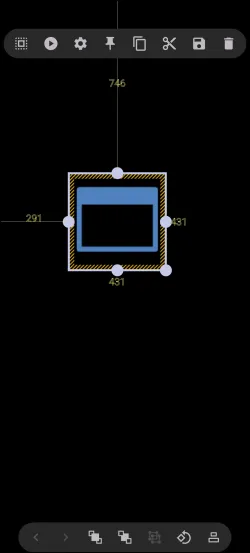
Window Object - Selected dialog. Make selection above.
Demo Navigation
When finished most users would further enhance the image with an action or editing its options. Find those navigation links in the headings below:
In Edit Mode and the Window Object (default) is Selected
Object Design Menu (Top)
Notice the Object Design Menu at both the top and bottom of the screen. The icons contained in these menus describe what will happen or what options are available for the selected object. Read below and even view a demo of what happens when specific icons are selected.
TOP 
Selection
 - Once the selection icon is tapped the user can drag left to partially intersect any object select or right to fully select any object.

Action
 - enables the object's action when tapped or swiped, such as application or folder or calendar.
- To navigate to that interactive ui page, click here.

Option
 - the text elements, such as the image form (image, folder, dynamic image, shape, etc.), opacity, background, even animation and more.
 - To navigate to that interactive ui page:


Pin
 - With an object selected and then the pin icon tapped, the object will now be visible in its current location on all pages of the setup.


Copy
 - Creates a copy of the object which can then be pasted, using the Object Add (+) - Paste option. The new copy will be placed on top of the existing object but can be selected and moved to the desired location.


Cut
 - Removes the object from the screen location and allow the user to then paste the item to another location (such as another page) using the Object Add (+) - Paste option.


Save
 - places a copy of the object in the Resource's “Saved” folder for future access


Delete
 - Removes the object from the page with no saving


Object Design Menu (Bottom)
BOTTOM 
Selection: Back - Forward
 Back - Grayed out in this dialog (inactive) since all objects on the page were selected. If multiple unselected objects existed, the user can cycle through all objects by tapping the icon, then proceed with the objects modification.
- For both the back and forward icons, see a demo here .
 Forward - Grayed out in this image (inactive) since all objects on the page were selected. If multiple unselected objects existed, the user can cycle through all objects by tapping the icon, then proceed with the objects modification.


Z-order: Front - Back
 Front - Grayed out in this image (inactive) since all objects were selected. If multiple overlapping unselected objects existed, this would bring the selected object to the front “layer” to appear before other objects
- For both the Z-order Front and Z-order Back icons, see a demo here .
 Back - Grayed out in this image (inactive) since all objects were selected. If multiple overlapping unselected objects existed, this would move the selected object to a “layer” behind other objects.


Group
 Group - While the 3 objects in this image are selected, they are currently separate objects. Tapping this icon, will cause the 3 objects to be grouped and become a single object. This is beneficial if needing to move the group items at the same time.


Rotate - Transform
 Rotate - Transform - Grayed out in this image (inactive) since more than 1 object is selected. If only a single object is selected, tapping the icon will open the rotate-transform dialog to rotate the object by it's x or y axis; transform the object's rotation, scaling, and translation … it's complicated, just experiment to learn.


Align
 Align - Grayed out in this image (inactive) since there all objects in the image were selected. If multiple objects exist, the user would tap the align icon which would reveal horizontal or vertical alignment bar when intersecting with another object. This is useful for centering or matching top/bottom areas of objects.


The action trigger for the example window object on the page was set as default (or actually “Do nothing”) but can now be changed.
- If this was the actual launcher app, a user would just tap the
Actionicon in the upper left of the screen. Pressing **here** on this interactive page will actually navigate to the “Action trigger” page as if in the TL app.

Options for Text-based versus Image-based Windows
The other alternative will be shown in the “Option” dialog when the Option icon  in the upper left of the screen is tapped.
- Windows can be activated by an Image object or a Text object. The options available are different
- For Image objects Click here to navigate. These will include: • Image • Opacity • Saturation • Color filter • Background and • Margins.
- For Text objects Click here to navigate. These will include: • Font, Size and Color • Background • Shadow • Margins and • Alignment.
===== Hidden Index Anchors ===== ui-object-image-default_unselected
Comments & Feedback
Toby Lancer is ready to help! Look for the Quick Help form:
► Desktop: left sidebar located near the bottom for Private to Admin
► Mobile: 3-bar menu at page top.
► Use the Discussion section below to share any experiences and communications with other Total Launcher users.
► Any Registered User can directly update this and any wiki page if desired.
Moderation: To keep the manual clean, all comments are held for appropriateness review. Preview any comment before submitting it. It will not display after submission until reviewed. So, please, do not resubmit.
Formatting: If using any code snippets place them inside code tags (e.g., 'code') using double single quotes (') before and after to keep them readable.
Be Kind: This is a community effort. Please keep feedback constructive and on topic.
~~DISCUSSION~~